
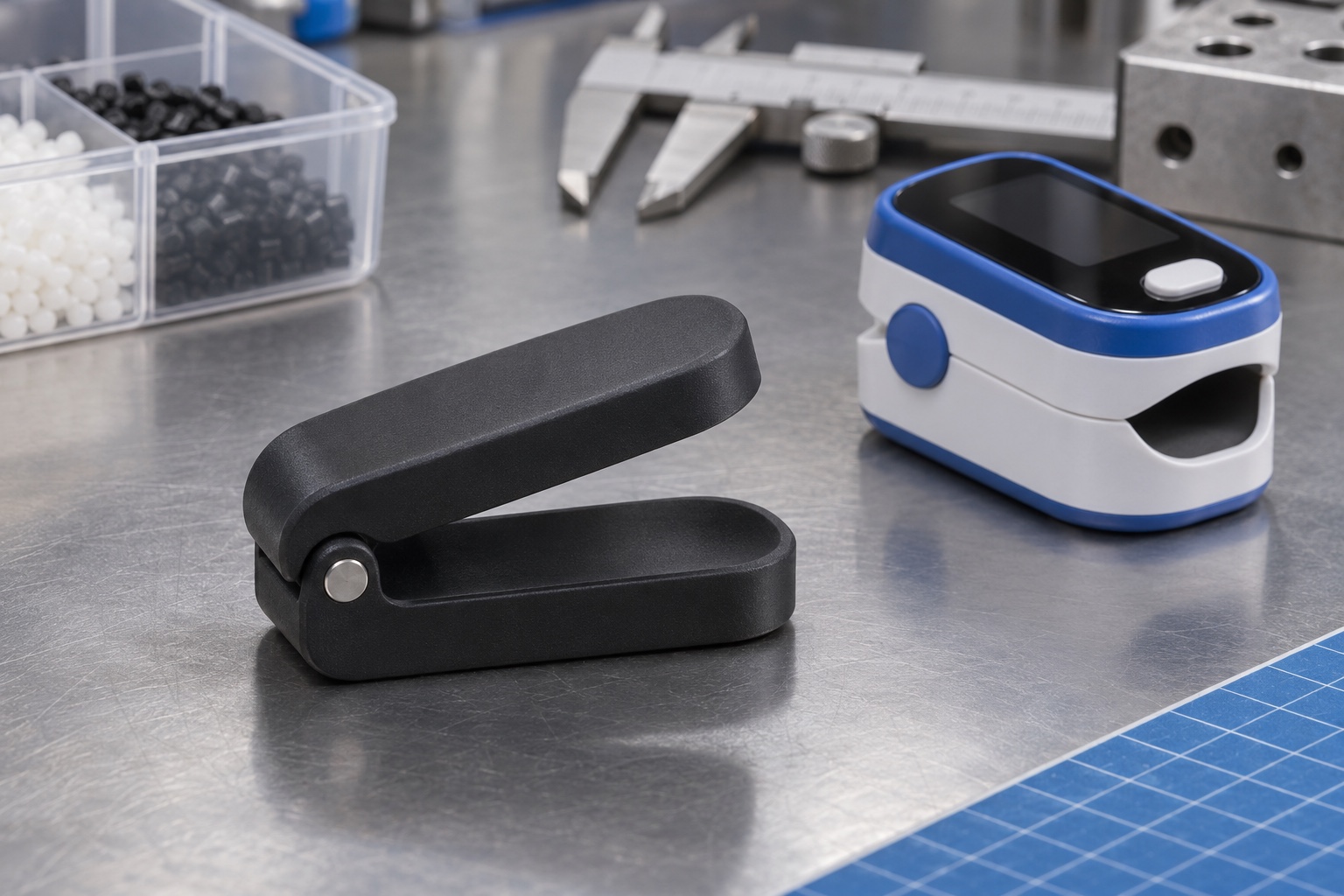
Define the scope of the POM-C hinge prototype
Precision CNC machining of a POM-C oximeter hinge prototype starts with two separate checks: whether the bores align with the reference pin, and whether the jaws clear each other through the intended travel. Both checks use a nonfunctional bench mockup.
Fingertip pulse oximeters may have a hinged enclosure that opens to admit a finger. A nonfunctional hinge mockup can help engineers study the relation between two jaws, a pin and an opening envelope. It cannot measure pulse or oxygen saturation and should not be tried on a person. The example does not include optics, electronics, a spring or a patient-contact surface specification. The first drawing review should name the mechanical question to be answered, such as how pin alignment affects free movement or whether a dummy stop causes interference.

Define the pin and bearing surfaces
The pin establishes an axis only through the surfaces that actually support it. Identify whether it rotates in one jaw or both, and where axial play is permitted in the bench setup. A nominal diameter on a drawing does not establish this relationship. Show the bearing length, edge transitions and any features that retain the pin in the hypothetical assembly. A pin should not be forced through misaligned bores during a fit check. If it enters from one side but binds partway, inspect the two bore segments and the assembly support before changing their size.
Measure relative geometry as well as hole size
Individual hole sizes can be acceptable while the assembled pin binds because the holes do not share the intended axis. Define the relationship of each bore to a reference on its jaw and, if relevant, to a common bench assembly reference. Use inspection methods appropriate to the required uncertainty and feature length. A pin that fits through an unloaded assembly can be a useful observation, but it is not proof of coaxiality or dynamic performance. Keep the required dimensional findings separate from the functional trial and document how both were obtained.
Give the jaws a clear travel envelope
Draw the position of each jaw at key points in the intended bench movement. The geometry around the hinge can clear at one angle and rub elsewhere. Use the mockup only within the motion defined by its owner, without a spring, actuating load or operating instrument. Specify where the jaws may intentionally contact a stop and which surfaces must stay clear. Do not infer opening dimensions or finger pressure from a picture. Clinical accommodation and force limits would require a separate device design and validation, neither of which is provided by the mockup.
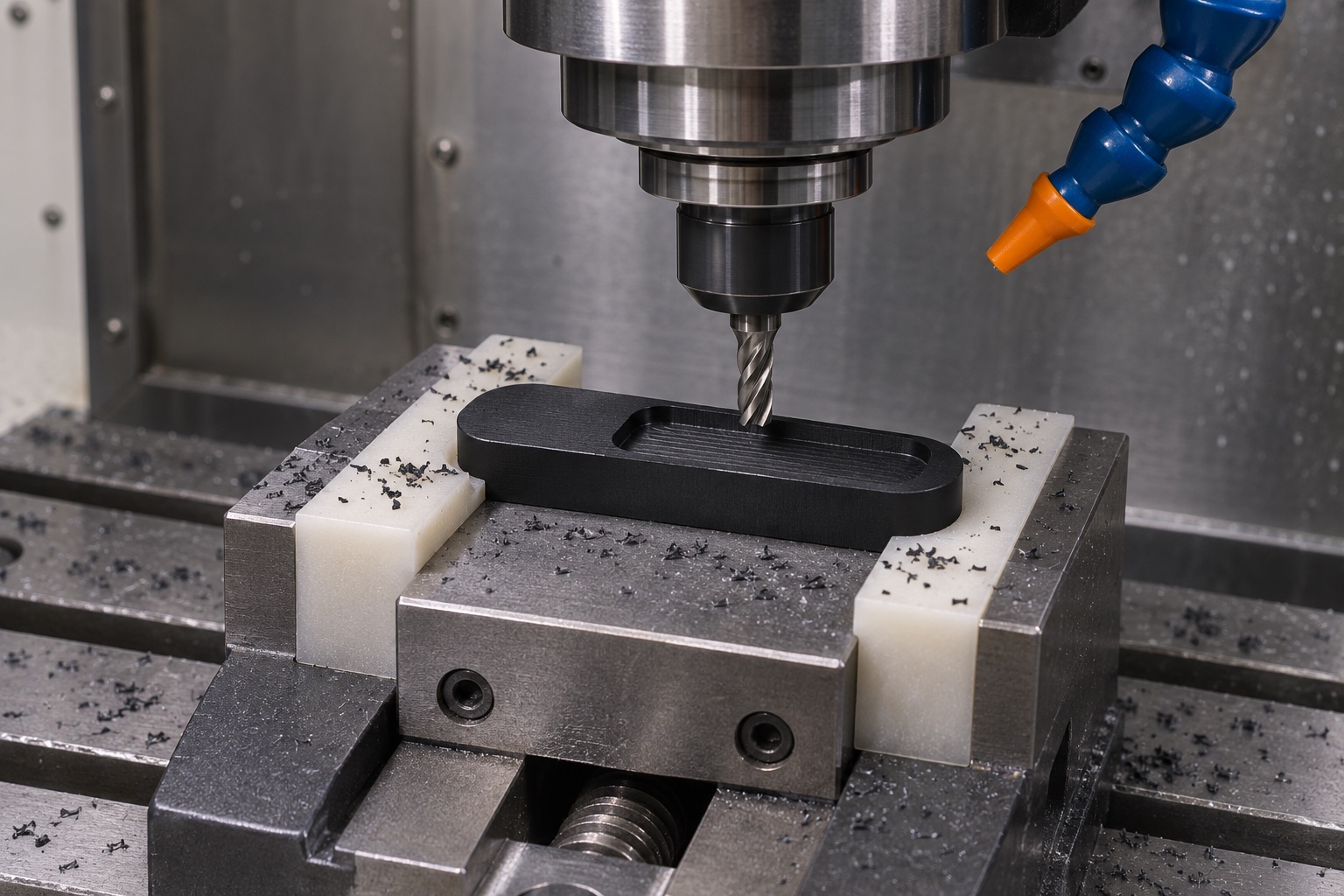
Design for CNC machining: thin sections in POM-C jaws
Removing stock around the hinge can leave flexible walls. Support the blank close to cutting loads and choose a sequence that preserves the bore reference. Rough the body while there is material to support it, then release and inspect before finishing if the part may move. Machining two jaws in related setups can simplify alignment only if the references are defined and reproduced. The illustrations show access, not an approved workholding method. Select cutters and conditions based on actual material, geometry and inspection needs rather than copying the appearance of the scene.
Treat polymer grade and finish as explicit requirements
POM-C can be considered for a machinable bench prototype, but stock form, material grade and final condition should be stated. Polymer shape may change under clamping, handling or environmental conditions. Record any conditions that affect measurement. Do not claim that a finish or black polymer is suitable for patient contact or device cleaning. No material or process is validated here for biocompatibility, optical properties, electrical insulation or device use. Those requirements belong to the complete design and must be verified separately from the mechanical prototype.
Finish edges without changing the reference
An entry edge may need a controlled break so a test pin can be placed without catching. Too much edge removal can shorten the bearing length or change which surface guides the pin. Inspect the actual support zone rather than a chamfer. Verify any relieved surface remains clear throughout the specified bench movement. Keep identification off the locating faces. If an edge is corrected after measurement, repeat the checks that can change. A smooth-looking part is not evidence of an acceptable pin fit, a measured travel envelope or safe handling in a clinical environment.
Check pin-bore alignment and unloaded jaw clearance
Check each jaw separately, then compare the assembled geometry in a supported state. Record pin identity, orientation and the locations used to observe clearance. Use a clearly identified inert reference if checking the jaw envelope, never a person. Observe movement by the defined bench method without forcing a bind. Record where an unexpected contact occurs and whether it follows one part after disassembly. The trial can show geometry under that setup only. It does not establish spring force, fatigue, drop resistance, sealing, signal quality, optical alignment or measurement accuracy.
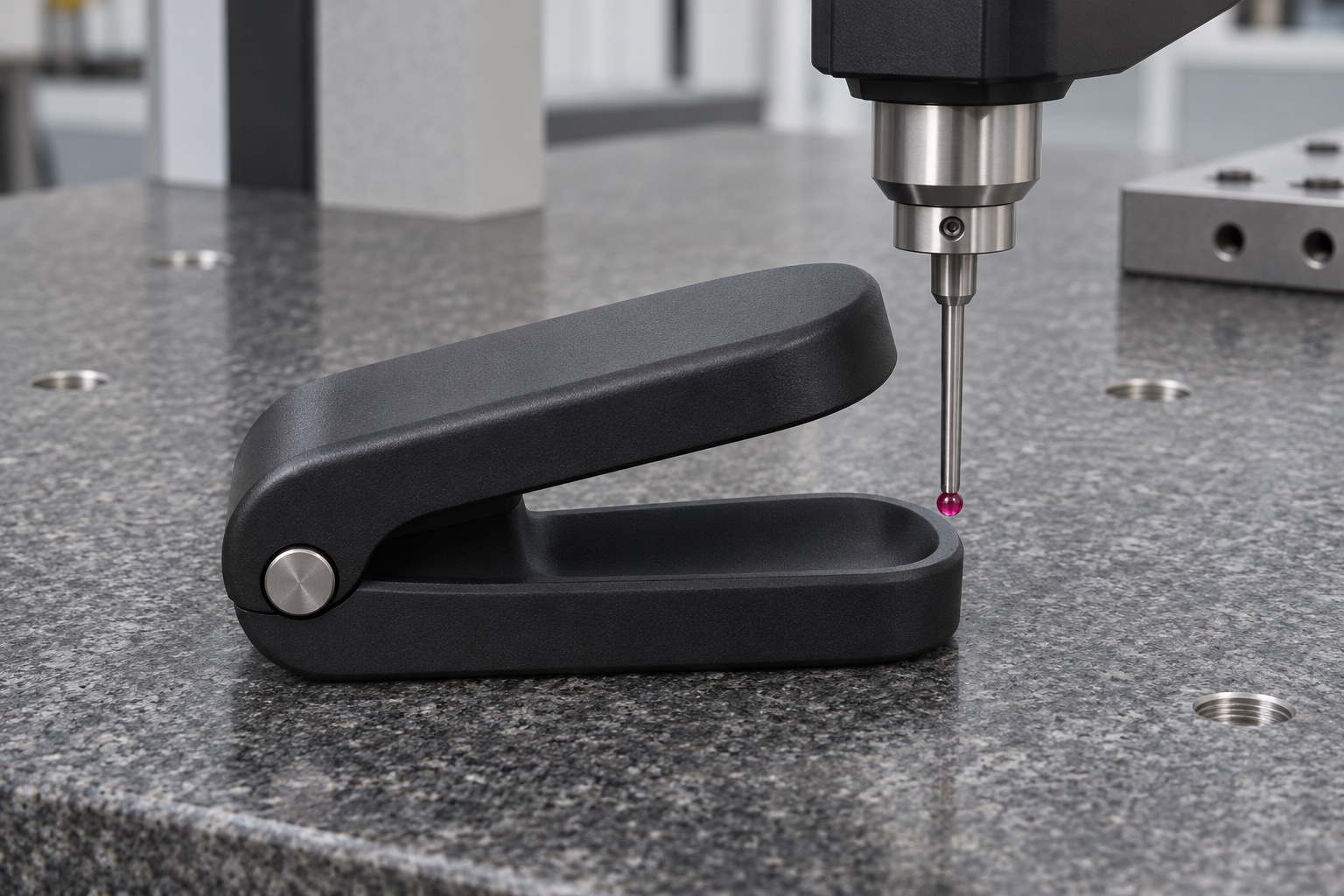
Diagnose a bind rather than enlarging both bores
First check the selected pin, part revisions and whether a burr or debris is present. Determine whether the resistance occurs at entry, through a bore segment or only at an angle after assembly. Compare the individual measurements with the assembly observation. If one jaw is replaced, record that change instead of mixing results from different pairs. Any authorized rework should be tied to a specific observation and followed by reinspection. Increasing clearance can mask an incorrect axis and change how the jaws move, so it is not a substitute for identifying the cause.
Distinguish a geometry report from safety evidence
A report can show the measured dimensions and observations from an unloaded trial, provided the drawing, instruments and conditions are recorded. It cannot infer how the enclosure will behave with a spring, electronics or a user. Mark any assumptions about future components as open items. Do not use an illustration of a commercial oximeter to imply approval or interoperability. The assembly is a development aid, not a specification for a device or a procedure for service. Keep clinical and equipment-level questions with the responsible owner and its approved verification methods.
Protect the jaw and pin references during transport
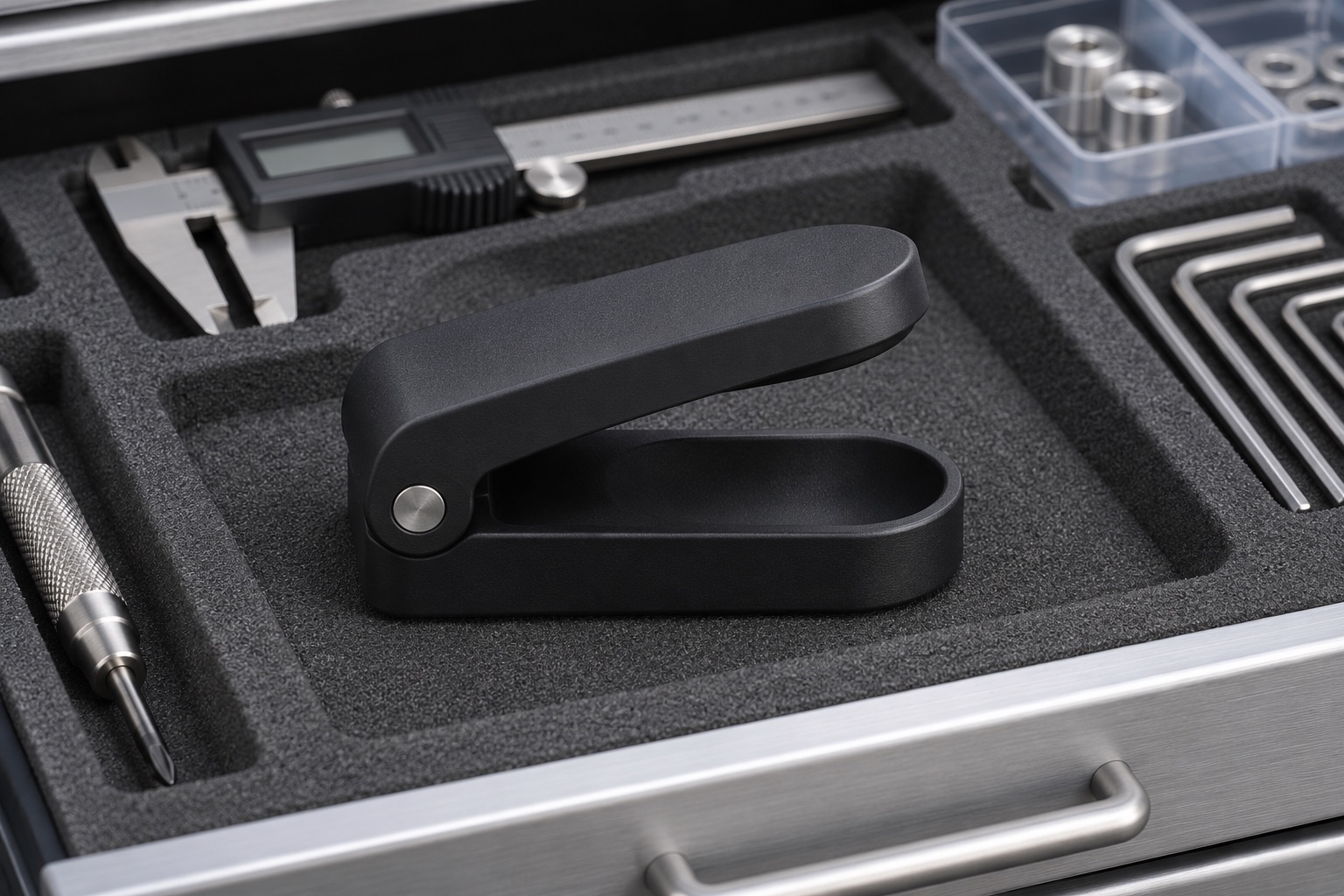
Support the jaws on nonfunctional exterior faces and separate loose pins from the bore edges. Do not leave the mockup partially assembled if the pin can move and strike a contact surface. Identify the mating pair and pin separately and link all three to the inspection record. At receipt, look for damage or debris before repeating a trial. Foam and a fitted insert protect parts against ordinary handling; they do not establish a sterile barrier, cleanroom class or validated storage duration. Any such requirement needs its own definition and evidence.
Give the next team a reproducible handover
Send the released jaw and pin drawings, intended bench travel, support state, material and inspection references. Ask for separate records of bore geometry, pin fit and any observed clearances. Identify unresolved interfaces rather than assuming the model suits a real device. This makes it possible for another team to repeat a specific mechanical check and understand what the result means. The prototype does not authorize installation, calibration or clinical use, and no patient-related or device-performance finding is implied by the CNC example.
FAQ
Can the mockup measure oxygen saturation?
No. It has no optical or electronic system and does not authorize use on a person.
Why check pin-bore alignment as well as bore diameter?
Correct sizes alone do not ensure a common pin axis. Inspect each required relationship relative to the drawing.
Does free motion establish a safe opening force?
No. The unloaded mockup has no spring and does not evaluate any clinical or equipment force requirement.
Can the same pin be used in every trial?
Only when the inspection plan identifies it and its condition is suitable. Record any change of reference before comparing results.
What should happen if the pin binds?
Check identity, burrs, support and geometry first. Do not force it or enlarge the bores without an approved correction.
Is the illustration a replacement-part drawing?
No. It is a generic bench concept and does not claim compatibility with a commercial instrument.
tanghangyun@oemach.com